Every Flat Cake Taught Me Something: Confessions from a Lifetime of Baking Blunders
Photo: Federal Bureau of Investigation, Public domain, via Wikimedia Commons
There's a particular kind of silence that fills a kitchen when you open the oven door and realize something has gone very, very wrong.
Maybe it's the cake that's supposed to be tall and golden but has instead developed a crater in the center deep enough to lose a spatula in. Maybe it's the smell — that unmistakable edge of burnt sugar that tells you the cookies you forgot about for just five more minutes are now somewhere between caramel and charcoal. Or maybe it's the soufflé that was puffed and glorious thirty seconds ago, and has now collapsed into a sad, eggy puddle the moment you walked it to the table.
I've experienced all of these. Multiple times. And I'm here to tell you that every single one of them made me a better baker.
The Cake That Taught Me to Read a Recipe All the Way Through
It was a birthday. Not just any birthday — my mother's 60th, the one I had been planning for weeks. I had decided, with the full confidence of someone who had made exactly four layer cakes in her life, that I would attempt a four-tier lemon chiffon with Italian meringue buttercream. From scratch. The morning of the party.
I got three layers in before I realized I had been using baking soda in a recipe that called for baking powder. These two ingredients are not the same. Baking soda is pure sodium bicarbonate and needs an acid in the recipe to activate. Baking powder already contains that acid, built right in, and is designed for batters without acidic components. Chiffon cake batter, as it turns out, does not have enough acid to activate baking soda properly — so my layers came out dense, slightly metallic-tasting, and about half the height they should have been.
The lesson: Read the entire recipe before you start. Not while you're measuring. Before. I now do a full dry-run read-through with a cup of coffee before I even touch a mixing bowl.
The Brownies That Refused to Set
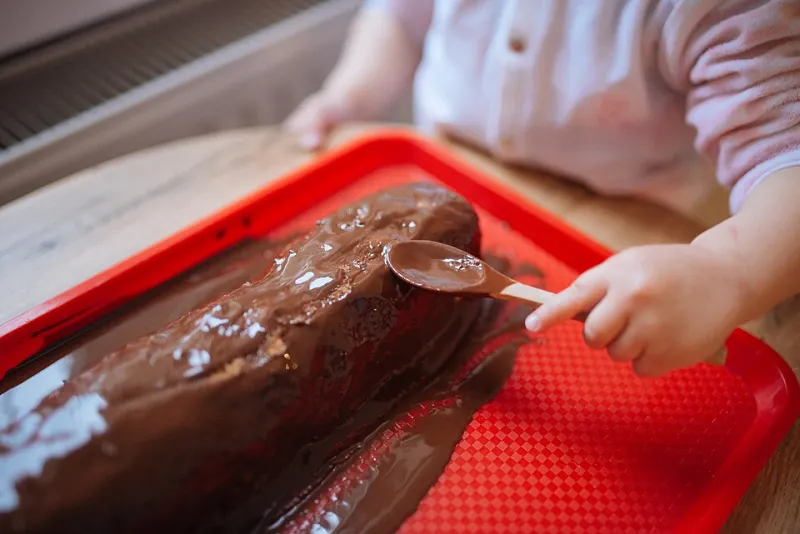
For about six months in my late twenties, I was obsessed with making the perfect fudgy brownie. Not cakey — fudgy. The kind with that crinkly, papery top and a dense, almost gooey center. I tried recipe after recipe, and every single batch came out either underdone to the point of being liquid in the middle, or overbaked into something more like a chocolate brick.
The problem, I eventually figured out, was that I didn't understand what "done" looked like for a brownie. Unlike a cake, which springs back when pressed, a fudgy brownie is supposed to jiggle slightly in the center when you pull it from the oven. It finishes cooking from residual heat as it cools. I had been baking my brownies until they looked set in the oven — which meant by the time they cooled, they were completely overdone.
The other issue? I was cutting them warm. Hot brownies are structurally a mess. The chocolate needs time to re-solidify, the egg proteins need to finish setting, and the whole thing needs to come down to room temperature before a knife goes anywhere near it. Patience, it turns out, is as much an ingredient as flour.
The Bread That Could Have Built a House
Somewhere around the time I first got serious about baking, I decided homemade sandwich bread was my next frontier. I followed a basic white bread recipe, kneaded the dough, let it rise, shaped it, let it rise again, and baked it with all the hope in the world.
What came out of the oven could generously be described as a decorative loaf. Dense, chewy in the wrong way, with a crust that required genuine effort to cut through. I made three more loaves before I figured out the culprit: my yeast was dead.
Yeast is a living organism, and it has a shelf life. Old yeast, or yeast that's been exposed to too much heat or moisture, simply won't activate properly. Now I always proof my yeast first — dissolving it in warm water (between 105°F and 115°F, because hotter than that kills it) with a pinch of sugar and waiting to see if it foams up within about ten minutes. If it doesn't bubble, the yeast goes in the trash and I start fresh. That small extra step saves an entire afternoon.
The Soufflé That Humbled Me Completely
I'll keep this one short, because the memory still stings a little. I served a chocolate soufflé at a dinner party. It rose magnificently in the oven. I carried it out with the pride of someone who had clearly mastered the most dramatic dessert in the French repertoire.
I set it on the table. My guests leaned in to look. And then, in real time, it sank. Not dramatically — just a slow, inevitable deflation, like a tire losing air.
What I learned: soufflés wait for no one. They must be served immediately out of the oven, with guests already seated and forks in hand. Also, opening the oven door too early (which I had done to peek, because I couldn't help myself) causes the temperature to drop and the structure to weaken before it sets. The soufflé was perfectly delicious as a pudding, but the lesson was clear: some baked goods demand that you work around them.
Why Failure Is the Best Teacher in the Kitchen
Here's what I've come to believe after years of disasters: a baking mistake is just a question your oven is asking you. Why did this sink? Why is this gummy? Why did this spread into a flat puddle instead of a cookie? Every failure has an answer, and finding that answer makes you genuinely better — not just at that one recipe, but at baking as a whole.
The bakers I admire most aren't the ones who never mess up. They're the ones who mess up, figure out why, and come back to the kitchen the next morning with fresh flour and a new idea.
At Sweet Pea Bakery, we really do believe that baking is baked with love and shared with joy — and that includes the love you put into trying again after things go sideways. Your flat cake isn't a failure. It's the beginning of a better one.